
Appointment no-shows are easy to dismiss as an inconvenience.
Someone forgets. A homeowner gets busy. A consultation disappears from the calendar, and the salesperson moves on.
But for a remodeling company, a missed appointment represents more than an empty time slot. It may represent hundreds of dollars in marketing costs, hours of administrative work, lost sales capacity, and a potentially valuable project that never had the opportunity to close.
A high no-show rate is one of the quietest ways revenue disappears from a remodeling pipeline.
What a Better Show-Up Rate Could Be Worth
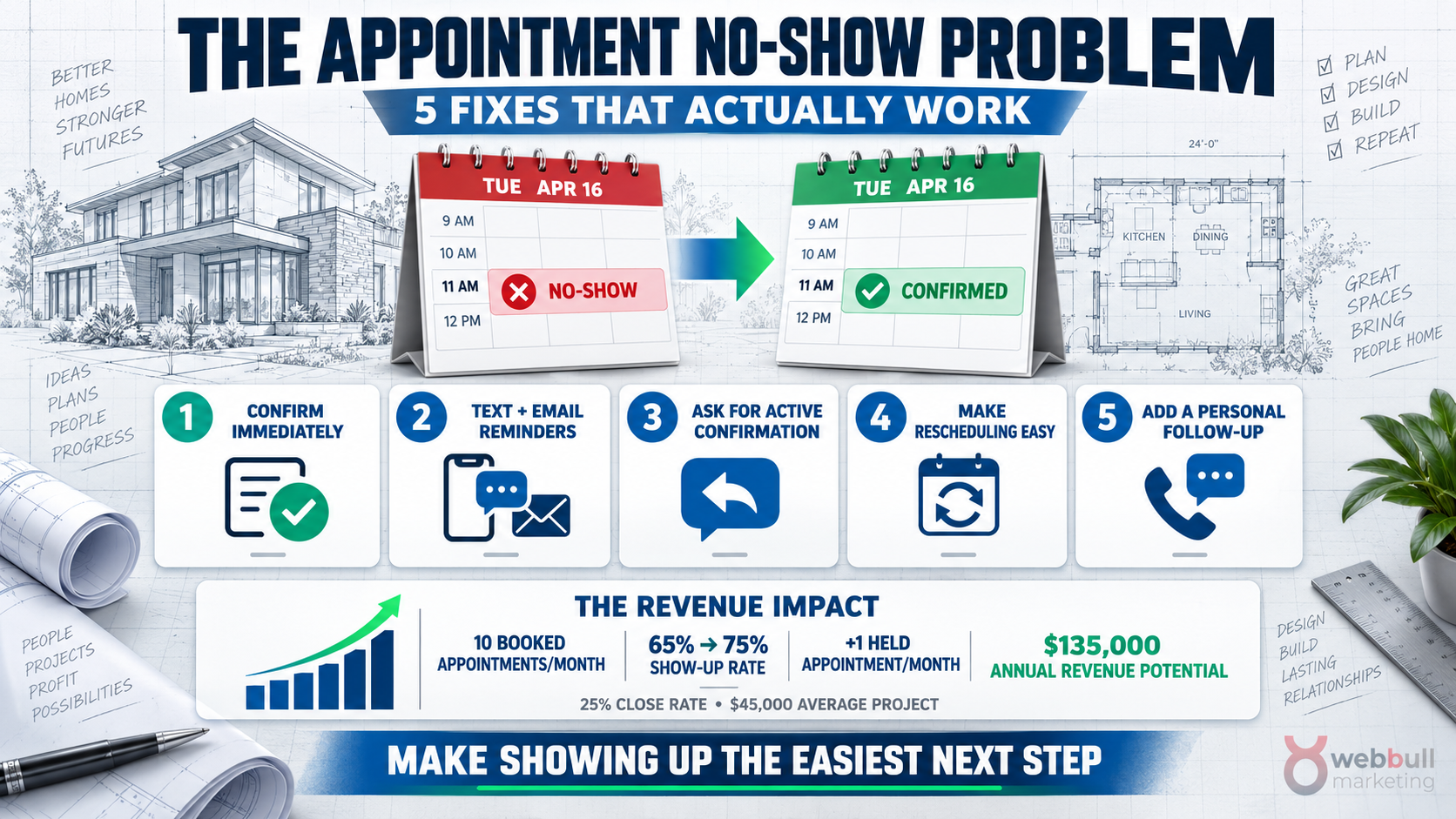
Consider a remodeling company that schedules 10 qualified consultations per month.
At a 65% show-up rate, the company completes an average of 6.5 consultations. Increasing the show-up rate to 75% produces an average of 7.5 completed consultations.
That is one additional held appointment per month.
If the company closes 25% of completed consultations and has an average project value of $45,000, that improvement represents:
- One additional held appointment per month
- An average of 0.25 additional signed projects per month
- Approximately three additional projects per year
- Approximately $135,000 in annual revenue potential
This is an average measured over time—not a prediction that the company will close one-quarter of a project every month. It is also potential revenue, not profit. Actual results depend on lead quality, sales performance, project capacity, margins, and other factors.
The calculation still demonstrates the larger point: getting more qualified prospects to attend appointments can produce meaningful growth without generating another lead.
Here are five practical ways to improve that number.
1. Confirm the Appointment Immediately
The confirmation process should begin as soon as the appointment is scheduled.
Send an immediate text message and email that include:
- The appointment date and time
- Whether it will be virtual, by phone, in the showroom, or at the property
- The name of the person conducting the consultation
- What the homeowner should prepare
- How to confirm or reschedule
- A calendar link or invitation
Do not make the prospect search through an old email thread to find the details.
An immediate confirmation makes the appointment feel official while the homeowner’s interest is still high. It also catches scheduling mistakes before they become no-shows.
2. Use Both Text and Email Reminders
One reminder through one communication channel is often not enough.
Email is useful for detailed information, but it is easy to overlook. Text messages are more immediate, but they are not ideal for explaining everything the homeowner needs to know.
Use both.
A simple reminder sequence might include:
- Immediate confirmation by text and email
- Email reminder 48 hours before the appointment
- Text reminder 24 hours before the appointment
- Brief final reminder a few hours before the appointment
The goal is not to bombard the prospect. It is to make forgetting unlikely.
Every reminder should clearly identify the company, state the appointment time, and provide an easy way to confirm or reschedule.
3. Ask for Active Confirmation
A reminder tells the homeowner an appointment exists. An active confirmation asks the homeowner to respond.
For example:
“Please reply YES to confirm your consultation for Tuesday at 2:00 PM. If you need a different time, reply RESCHEDULE and we’ll help you find one.”
That small action matters. It requires the prospect to mentally recommit to the appointment.
If the homeowner does not confirm, the team has time to follow up before the scheduled meeting rather than discovering the problem after the salesperson is already waiting.
Active confirmation also helps distinguish an engaged prospect from someone whose priorities or plans have changed.
4. Make Rescheduling Easier Than Disappearing
Some no-shows happen because the prospect cannot attend but feels uncomfortable calling to cancel.
Give homeowners an easy alternative.
Include a rescheduling link or a simple instruction such as:
“Need another time? Reply RESCHEDULE and we’ll take care of it.”
A rescheduled consultation is still an opportunity. A no-show followed by silence usually is not.
Avoid language that makes rescheduling sound like an inconvenience to your team. The goal is to preserve the conversation and keep the prospect moving—not punish someone because Tuesday stopped working.
At the same time, do not allow unlimited self-rescheduling without oversight. Repeated changes can indicate low urgency or poor fit and may justify another qualification conversation.
5. Add a Personal Follow-Up
Automation should support the relationship, not replace it.
For higher-value remodeling consultations, a brief personal call or text from the salesperson can materially change how committed the appointment feels.
The message does not need to be elaborate:
“I’m looking forward to speaking with you tomorrow about your kitchen renovation. I reviewed the information you submitted and have a few ideas and questions ready. Please let me know if anything changes before our 2:00 PM consultation.”
This accomplishes several things:
- It demonstrates preparation
- It makes the interaction feel personal
- It reinforces the value of attending
- It gives the homeowner another opportunity to ask questions
- It creates accountability between two real people
For an in-home consultation, confirm the property address, parking instructions, decision-makers attending, and any access details. For a virtual consultation, resend the meeting link.
Make the Appointment Feel Worth Attending
Reminders solve forgetfulness. They do not solve weak perceived value.
If prospects frequently schedule consultations but fail to attend, review how the appointment is being positioned.
“Free consultation” can sound vague and disposable. Instead, explain what the homeowner will receive from the conversation.
Will the consultation help determine whether the project scope matches the available budget? Will the homeowner learn what the process involves, what decisions must be made, and whether the firm is the right fit?
The more specific the expected value, the more seriously the appointment is likely to be treated.
Track No-Shows Separately From Cancellations
A cancellation and a no-show are not the same outcome.
Track at least four appointment statuses in the CRM:
- Confirmed and attended
- Rescheduled
- Cancelled
- No-show
Then calculate the show-up rate consistently:
Completed appointments ÷ booked appointments = show-up rate
Review the number monthly and by lead source. If one campaign produces many appointments but an unusually high percentage never attend, its apparent lead volume may be hiding poor intent or weak qualification.
Also review no-show rates by salesperson, appointment type, scheduled wait time, and day of the week. The pattern may reveal a process problem that is invisible in the company-wide average.
The Bottom Line
A missed appointment is not merely a calendar problem. It is a conversion problem.
Before spending more money to generate additional leads, make sure qualified prospects are consistently reaching the consultations already being scheduled.
Confirm appointments immediately. Use text and email reminders. Ask for an active response. Make rescheduling easy. Add a personal touch for high-value opportunities.
Most importantly, make the consultation feel valuable enough to attend.
Improving the show-up rate by even 10 percentage points can create meaningful additional revenue over time—without increasing traffic, advertising spend, or lead volume.