
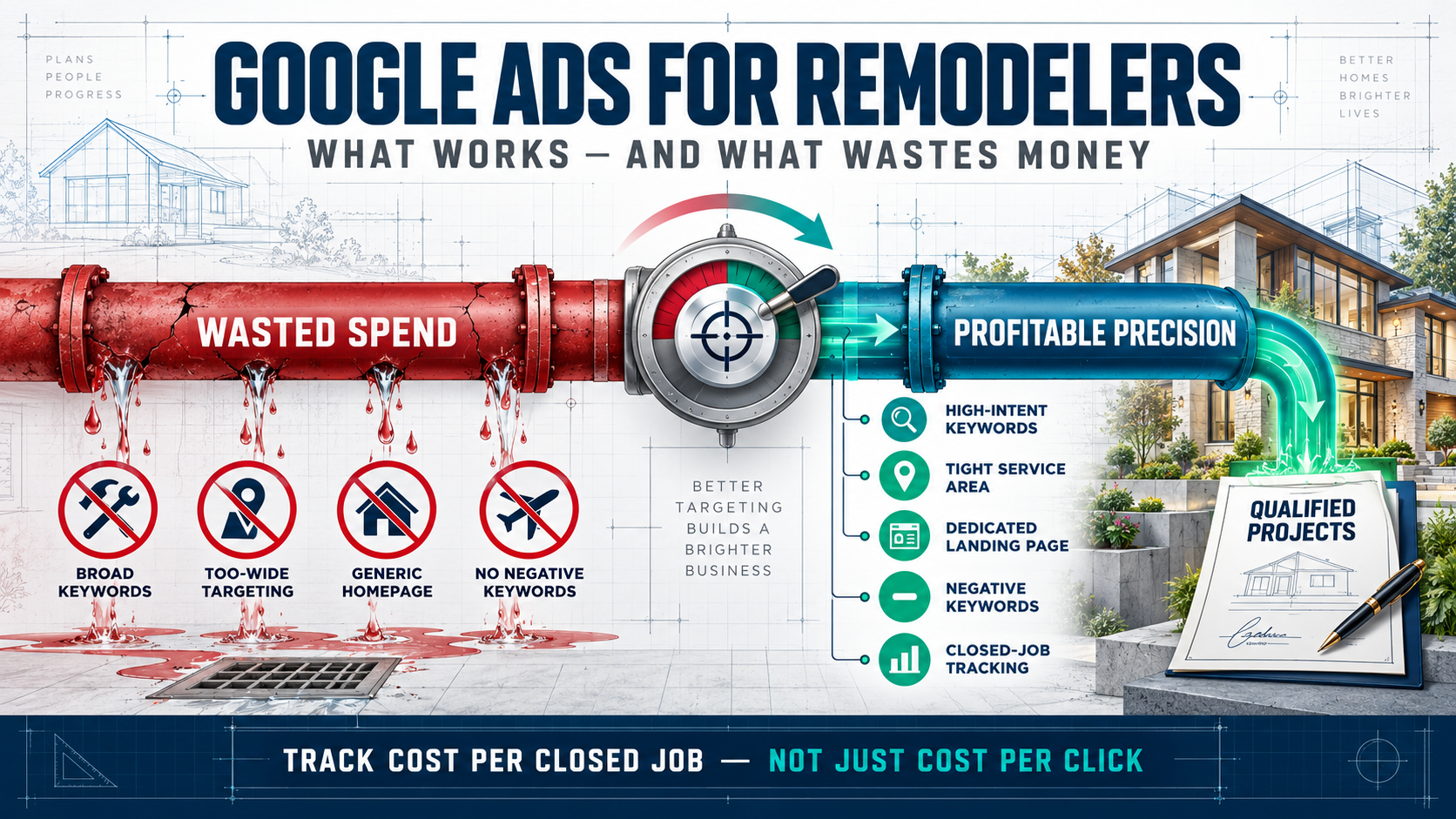
Google Ads has a reputation among remodeling business owners as either a growth engine or a money pit, often based on one bad experience rather than a clear understanding of what actually drives performance. The truth is closer to this: Google Ads rewards precision, and punishes the generic setup that many companies start with and never revisit.
Broad keywords are usually where budget disappears
Bidding on broad terms like "home remodeling" or "kitchen renovation" without tight qualifiers often pulls in a wide mix of intent — some genuine high-end prospects, but also a lot of DIY researchers, out-of-area searches, and budget-mismatched inquiries. More specific terms tied to your actual services, project types, and price point tend to cost more per click but convert at a meaningfully higher rate, which usually makes them cheaper per lead in the end.
Geographic targeting deserves more attention than it gets
It's common to see remodeler ad accounts targeting an entire metro area when the company realistically only serves a 20-30 minute radius from their base of operations. Every click from outside your real service area is wasted spend on a lead you were never going to take on. Tightening geographic targeting is one of the fastest ways to cut wasted budget without touching anything else.
Landing pages matter as much as the ad itself
Sending paid traffic to a generic homepage instead of a page built around the specific service or project type the ad promised is one of the most common and most expensive mistakes. A visitor who clicked an ad for "kitchen remodeling" and lands on a general "our services" page has to do extra work to find what they were looking for — and a meaningful share of them simply won't.
Negative keywords are not optional
Excluding irrelevant searches — "DIY," "cheap," "jobs," "how to," and similar terms depending on your business — prevents your budget from being spent on clicks that were never going to convert. An account without a maintained negative keyword list tends to accumulate wasted spend slowly and invisibly over time.
Tracking has to go beyond "cost per click"
Cost per click and cost per lead are useful, but the number that actually matters is cost per closed job. A campaign with a higher cost per lead that consistently brings in serious, qualified prospects can easily outperform a cheaper campaign filling your pipeline with unqualified inquiries. This is where connecting ad performance back to your CRM and actual close rates becomes essential, rather than judging a campaign on lead volume and cost alone.
A reasonable way to think about budget
Rather than asking "how much should I spend on Google Ads," a more useful question is "what's the maximum I can spend per lead and still hit my target close rate and profit margin." That number, calculated from your own pipeline data, should set your bidding strategy — not a generic industry benchmark that doesn't account for your actual average project value or sales process.
The honest bottom line
Google Ads isn't inherently expensive or inherently efficient — it reflects the precision of the setup behind it. A tightly targeted campaign with the right landing pages and real tracking back to closed revenue tends to perform well for high-end remodelers specifically because the audience searching with genuine intent is smaller and more valuable than in most industries. A loose, generic setup wastes budget in exactly the same market.