Website traffic is one of the easiest marketing metrics to report—and one of the easiest to overvalue.
A remodeling company can attract thousands of visitors without producing enough qualified opportunities to justify the effort. Another company can receive less traffic but generate far more meaningful action from the homeowners who arrive.
That is why the most revealing number in this anonymized home renovation SEO case study is not total traffic or keyword movement.
It is the relationship between traffic and conversions.
During the reporting period from December 2022 through July 2023, organic search accounted for:
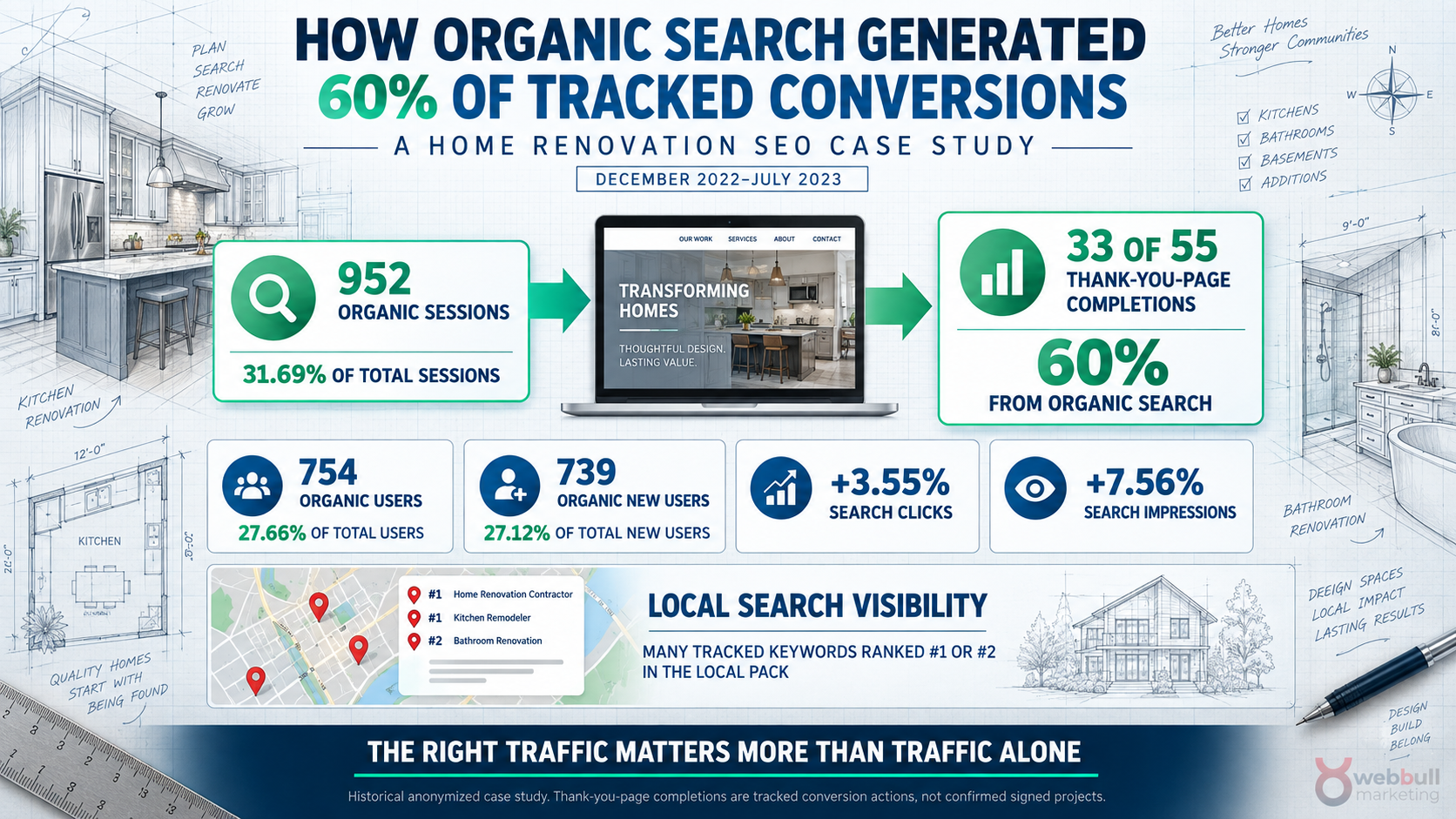
- 31.69% of total website sessions
- 60% of tracked thank-you-page completions
In other words, organic search produced less than one-third of the website’s sessions while generating three-fifths of its tracked conversion actions.
That is the difference between attracting more traffic and attracting the right traffic.
The Campaign Overview
The home renovation company had been participating in an ongoing SEO campaign for close to a year.
The campaign tracked performance across several areas:
- Organic users
- New organic users
- Organic sessions
- Page engagement
- Thank-you-page completions
- Search impressions
- Search clicks
- Average organic position
- Local Pack rankings
- Local Finder rankings
The source report covered website acquisition and conversion data from December 2022 through July 2023.
The company competed for valuable remodeling searches, including variations related to:
- Home renovation
- Kitchen remodeling
- Bathroom remodeling
- Home design and remodeling
- Remodeling services near the searcher
- Local renovation companies
These are commercially meaningful searches because they can reflect homeowners actively researching potential remodeling partners—not merely browsing design inspiration.
Organic Search Generated 952 Sessions
Organic search produced 952 sessions during the measured period.
Those visits represented 31.69% of all website sessions.
Organic search also contributed:
- 754 users, representing 27.66% of total users
- 739 new users, representing 27.12% of total new users
These figures show that organic search was an important acquisition channel, but it was not responsible for most of the website’s traffic.
Other channels collectively delivered more than two-thirds of total sessions.
If the analysis stopped there, organic search might appear to be one valuable channel among several.
The conversion data tells a much stronger story.
Organic Search Generated 60% of Tracked Completions
The website recorded 55 thank-you-page completions during the reporting period.
Organic search produced 33 of them.
That means organic visitors generated 60% of all tracked thank-you-page completions.
Based on the figures in the report, organic traffic generated an approximate thank-you-page completion rate of 3.47%:
33 organic completions ÷ 952 organic sessions = approximately 3.47%
A thank-you-page completion typically occurs after a visitor submits a form or completes another tracked action that redirects to a confirmation page.
It is important not to call these 33 completed remodeling projects—or even automatically call them qualified leads.
The report confirms tracked conversion actions, not final sales outcomes.
Still, the relationship is significant:
- Organic search produced 31.69% of sessions.
- Organic search produced 60% of tracked completions.
Organic traffic therefore contributed conversion activity at a much higher proportion than its share of overall sessions.
That is what traffic quality looks like in the numbers.
Why Organic Visitors May Convert Differently
A visitor’s source often says something about the person’s intent.
Someone who searches for “home renovation near me” or “bathroom remodeling service” may already have:
- Identified a specific need
- Started researching local contractors
- Considered a particular type of project
- Reached a more active stage of the buying process
That visitor behaves differently from someone who encounters a remodeling company casually through social media or follows an unrelated referral link.
This does not mean organic traffic is always superior to every other source.
It means traffic sources should not be judged by volume alone.
For a remodeler, 100 visits from homeowners actively researching a relevant local service may be more valuable than 1,000 visits from loosely related informational searches.
The only way to know is to connect each source to meaningful actions.
Local Visibility Supported High-Intent Discovery
The campaign also tracked visibility in Google’s Local Pack and Local Finder.
The Local Pack is the map-based group of business results that frequently appears for searches with local intent. The Local Finder is the expanded collection of map listings a user can view after opening more local results.
The source report showed strong positions for several tracked terms.
Many keywords ranked first or second in the Local Pack or Local Finder, including variations related to:
- Kitchen design and remodeling
- Bathroom design and remodeling
- Bath remodeling services
- Home design and remodeling
- Home renovation
- Home renovation near me
- Kitchen renovation
- Remodeling and design
Several tracked keywords also improved by one or two positions during the measured campaign period.
A move from second to first place may sound small compared with a jump of 20 positions in regular organic results. In a local map environment, however, moving among the top few positions can materially affect visibility because only a limited number of businesses receive prominent placement.
Local Rankings and Organic Rankings Are Not Identical
One detail in the report deserves clarification.
A business can rank first in the Local Pack for a keyword while holding a much lower position in traditional organic results.
Those are different search surfaces with different result formats.
Local visibility can be influenced by factors such as:
- Relevance to the search
- The searcher’s proximity to the business or service area
- Google Business Profile completeness
- Review signals
- Consistent business information
- Local authority
- Website relevance
- Local links and mentions
Traditional organic rankings depend more heavily on the website’s content, authority, technical quality, and relevance to the query.
A strong remodeling search strategy should monitor both.
The Local Pack can generate immediate calls and website visits from nearby homeowners. Organic rankings can expand visibility for service pages, project content, planning resources, and longer research queries.
Search Visibility Showed Supporting Improvement
The campaign report showed:
- A 3.55% increase in total search clicks
- A 7.56% increase in total search impressions
- An improvement in reported average position from 51.2 to 48.6
These figures indicate broader search visibility and modest click growth.
They should be interpreted carefully, however.
The comparison periods shown in the source report were not identical in length. That means these percentages are useful as supporting campaign-report figures, but they should not be treated as a perfectly controlled year-over-year comparison.
The conversion contribution is the more persuasive result because it connects organic sessions with a recorded action on the website.
Rankings and impressions indicate opportunity. Conversions indicate that at least some of that opportunity turned into measurable engagement.
The Website Recorded More Than 5,700 Pageviews
Across all traffic sources, the website generated:
- 5,720 total pageviews
- 5,021 unique pageviews
Frequently visited content included:
- The homepage
- Portfolio
- Contact page
- About page
- Get-started page
- Kitchen-remodel cost content
- News or blog content
- Testimonials
- Individual project pages
This mix highlights the different jobs a remodeling website must perform.
Informational content may attract the homeowner during research. Project pages and portfolios establish visual credibility. Testimonials reduce perceived risk. About and process pages help evaluate the company. Contact and get-started pages capture the response.
SEO cannot be isolated from those supporting pages.
Bringing a homeowner to the website is only the beginning. The rest of the site must help that person build confidence and take the next step.
What This Case Study Actually Demonstrates
The case study does not prove that every remodeling company will produce the same traffic, rankings, or conversion distribution.
It demonstrates several broader principles.
1. Traffic Share and Conversion Share Are Different
Organic search generated 31.69% of sessions but 60% of tracked completions.
A channel’s contribution to business results can be much larger than its contribution to total traffic.
2. Local Intent Can Be Highly Valuable
Many of the strongest tracked rankings involved local, service-specific remodeling searches.
These phrases are more commercially relevant than broad informational traffic with no connection to the company’s services or market.
3. Conversion Tracking Changes the Conversation
Without thank-you-page tracking, the company could report users, sessions, clicks, and rankings.
With conversion tracking, it could see that organic search generated most of the recorded completions.
That is a far more useful insight.
4. Small Ranking Movements Can Matter Near the Top
Moving from second to first in a local result is different from moving from position 52 to 51 in traditional results.
Rank changes should be evaluated based on where the keyword started, what type of result is involved, and whether the query attracts relevant homeowners.
5. The Entire Website Supports Organic Performance
Portfolio, contact, testimonial, project, and informational pages all contribute to the visitor’s decision.
SEO may create the visit, but the overall website experience influences whether that visit becomes a response.
What Remodelers Should Track
A useful remodeling SEO report should go beyond traffic and rankings.
At minimum, track:
- Organic users
- Organic sessions
- Qualified organic inquiries
- Form submissions
- Phone calls from organic visitors
- Consultation requests
- Local-profile website clicks
- Local-profile phone calls
- Local Pack visibility
- Service-page engagement
- Portfolio engagement
- Qualified-lead rate
- Closed projects attributed to organic search
- Revenue associated with those projects
Thank-you-page completions are a useful starting point, but they should eventually be connected to the CRM.
That connection helps answer the questions that matter most:
- Did the inquiry meet the company’s qualification standards?
- Did the homeowner schedule a consultation?
- Did the appointment occur?
- Was a proposal delivered?
- Did the project close?
- What was the final contract value?
Without that connection, the business knows organic search created responses—but not necessarily whether it created profitable projects.
Do Not Confuse Better Measurement With Better Performance
One warning deserves attention when comparing conversion data over time.
An increase in tracked conversions can result from actual performance improvement, better tracking, or a combination of both.
For example, repairing a broken form-tracking process may cause reported conversions to increase even if the number of real inquiries remains unchanged.
Businesses should document changes to:
- Analytics platforms
- Conversion definitions
- Forms
- Thank-you pages
- Call-tracking systems
- Cookie-consent tools
- CRM integrations
Reliable comparisons require consistent definitions.
A “conversion” must mean the same thing in both reporting periods.
The Practical Lesson for Remodeling Companies
Most remodeling companies do not need the largest possible audience.
They need sufficient visibility among homeowners who:
- Live within the real service area
- Want the services the company provides
- Have an appropriate project
- Can support the likely investment
- Are actively evaluating next steps
That is why SEO strategy should prioritize relevance before raw reach.
A practical starting sequence is:
- Define the highest-value services and locations.
- Build substantial pages around those services.
- Optimize the local business profile.
- Publish useful content for real homeowner questions.
- Strengthen project galleries and proof.
- Track calls, forms, and consultation requests.
- Connect organic inquiries to CRM outcomes.
- Improve the pages attracting traffic but failing to convert.
The objective is not merely to rank.
It is to create a measurable path from relevant search to qualified opportunity.
The Bottom Line
During this historical campaign period, organic search generated:
- 952 sessions
- 754 users
- 739 new users
- 33 of 55 tracked thank-you-page completions
- 60% of the website’s recorded conversion actions
Organic search accounted for only 31.69% of total sessions, yet it produced the majority of tracked completions.
That is the central lesson from this case study:
The right traffic matters more than traffic alone.
Rankings, impressions, and clicks can show whether visibility is improving. The real value emerges when relevant homeowners reach the website, engage with the company, and take a measurable next step.
This anonymized historical case study reflects data reported for a specific campaign period. Thank-you-page completions are tracked website actions and should not automatically be interpreted as qualified leads or signed remodeling projects. Results vary by market, competition, website quality, tracking accuracy, implementation, and other factors.