Local SEO is often reduced to a checklist:
Update the business profile. Get more reviews. Add a few city names to the website. Publish an occasional blog post.
Those activities may help, but isolated tactics rarely produce the strongest results.
In this anonymized historical case study, a Dallas-Fort Worth home renovation company needed to increase its visibility across a competitive service area and generate more opportunities for its two primary services:
- Kitchen remodeling
- Bathroom remodeling
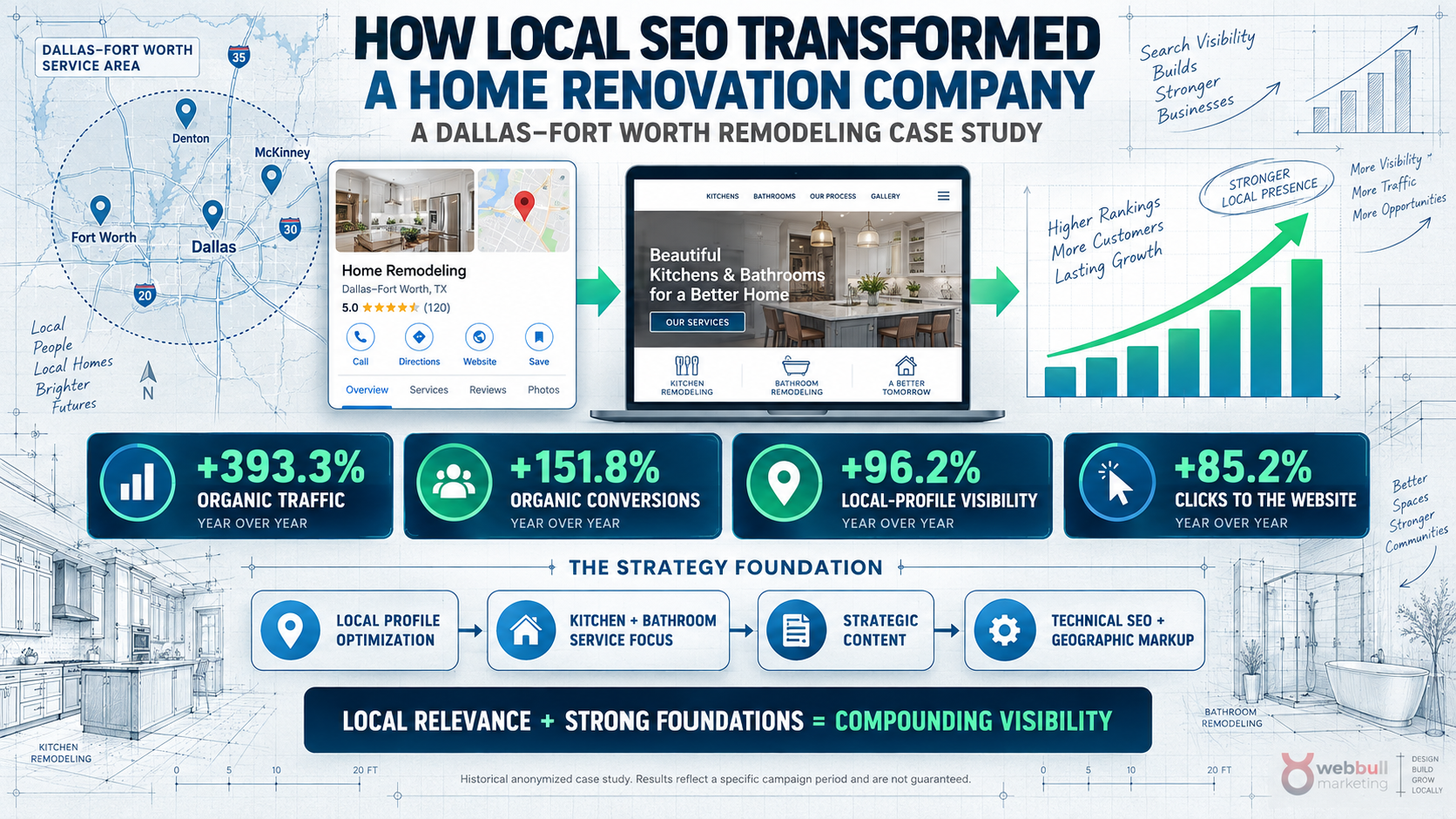
The campaign combined local-profile optimization, focused service positioning, strategic content, technical SEO, and clearer geographic signals.
The reported year-over-year results included:
- A 393.3% increase in organic traffic
- A 151.8% increase in organic conversions
- A 96.2% increase in local-profile visibility
- An 85.2% increase in clicks from the local profile to the website
The lesson is not that one particular tactic creates explosive growth.
The lesson is that local visibility compounds when the business, website, content, and geographic signals all tell the same clear story.
The Challenge: Standing Out Across Dallas-Fort Worth
The company needed to increase its presence throughout the Dallas-Fort Worth market.
That is not a small or simple service area.
The region contains numerous cities, suburbs, neighborhoods, property types, and competitors. A homeowner searching for a kitchen remodeler in Dallas may see different results from someone making a similar search in Fort Worth, McKinney, Denton, or another nearby community.
Broadly stating “We serve DFW” was not enough.
Search engines needed consistent information about:
- What the company offered
- Where it operated
- Which services were most important
- Which pages should rank for those services
- How the business’s website and local profile related to one another
Prospective clients needed the same clarity.
The campaign therefore focused on creating a stronger connection among the company’s services, service area, local profile, website, and content.
The Strategic Objective
The objective was straightforward:
Increase local visibility and generate more organic conversion opportunities for a home renovation company specializing in kitchen and bathroom remodeling.
That required more than attracting additional website visitors.
The right homeowners needed to:
- Find the company in local and organic search.
- Understand what the company specialized in.
- Recognize that it served their location.
- Reach a relevant service page.
- Take a measurable next step.
The campaign addressed each part of that path.
1. Strengthening the Local Business Profile
One major component was optimizing the company’s local business listing—then called Google My Business and now known as Google Business Profile.
For a service-area remodeling company, the profile can be one of the most visible assets in the entire search strategy.
It may appear when homeowners search for phrases such as:
- Kitchen remodeler near me
- Bathroom remodeling company Dallas
- Home renovation contractor Fort Worth
- Design-build remodeling company
- Local kitchen renovation company
An incomplete or inconsistent profile makes it harder for prospective clients to understand the business. It may also weaken the consistency of the company’s broader local-search presence.
The optimization work focused on clearly representing the company’s services, location, and market relevance.
During the measured period, visibility for the local listing increased by 96.2% year over year.
Clicks from the listing to the company’s website increased by 85.2%.
That second number matters.
Visibility creates an opportunity, but the profile must also persuade homeowners to learn more. The increase in website clicks showed that more searchers were not only encountering the business—they were taking the next step.
2. Focusing on the Most Important Services
The strategy concentrated on the company’s two core services:
- Kitchen remodeling
- Bathroom remodeling
That focus helped prevent the website from becoming a vague collection of general renovation terms.
Search engines and homeowners both benefit from specificity.
A company that says it handles “all types of home improvement” may be technically accurate, but the message is less useful to someone actively researching a $75,000 kitchen renovation.
Focused positioning makes it easier to create:
- Relevant service pages
- Stronger page titles and headings
- Detailed project content
- Service-specific calls to action
- Locally relevant articles
- Clear internal linking
- Better alignment with search intent
The company’s core services became central themes rather than being buried inside a long list of capabilities.
3. Building a Strategic Content Plan
The campaign used content to support the company’s service and geographic priorities.
Strategic content is different from publishing articles simply to keep a blog active.
Every page should have a reason to exist.
For a remodeling business, that purpose might be to:
- Explain a specific service
- Answer a homeowner’s planning question
- Demonstrate local experience
- Address investment expectations
- Feature a completed project
- Explain the design-build process
- Support an important service-area page
- Help a prospective client take the next step
A strong content plan also connects pages.
An article about planning a kitchen renovation can link to the kitchen-remodeling service page. A local project case study can reinforce both the service and the location. A cost guide can move a homeowner toward a consultation after setting more realistic expectations.
This creates a useful body of information instead of a pile of disconnected posts.
4. Improving the Technical SEO Foundation
The campaign also included foundational research, implementation, and technical SEO work.
Technical problems can limit results even when the visible content appears strong.
Common issues on remodeling websites include:
- Important pages that are difficult to crawl
- Duplicate or weak page titles
- Confusing page hierarchy
- Broken internal links
- Slow mobile performance
- Missing or inconsistent metadata
- Thin service-area pages
- Pages competing against one another
- Poor conversion tracking
- Inconsistent business information
Technical SEO helps search engines access, interpret, and organize the website’s content.
It also creates a stronger foundation for future service pages, project features, and local content.
5. Clarifying Geographic Relevance
Geographic markup was implemented to provide search engines with additional machine-readable context about the business’s location and services.
Structured data can clarify information such as:
- Business type
- Service area
- Address
- Contact information
- Services
- Website relationships
Markup should not be treated as a magic ranking switch.
Adding code to a poorly structured website will not automatically produce local visibility. It is most useful when it accurately supports information already presented clearly on the site.
In this campaign, geographic markup worked alongside the local listing, service strategy, content, and technical improvements.
The power came from consistency across the complete system.
The Results
The coordinated program produced substantial year-over-year improvements.
Organic Traffic Increased by 393.3%
Organic traffic increased by 393.3% year over year during the reported campaign period.
That indicates the website became substantially more visible and attracted significantly more visitors from unpaid search results.
Traffic growth alone, however, is not enough to declare success.
A renovation company does not benefit simply because more people viewed its website. Those visitors must be relevant to the company’s services and location—and the website must give them a reason to respond.
That is why the conversion result is especially important.
Organic Conversions Increased by 151.8%
Organic conversions increased by 151.8% year over year.
A conversion represents a defined action, such as a form submission, phone call, consultation request, or another tracked response.
It should not automatically be interpreted as a signed remodeling contract.
Even with that distinction, the result shows that the campaign improved more than website visibility. It produced a meaningful increase in the actions connecting organic search with the company’s sales pipeline.
Local-Profile Visibility Increased by 96.2%
Visibility for the local business listing increased by 96.2% year over year.
This meant the business appeared more frequently when prospective customers searched for relevant local services.
For a remodeling company, that visibility can be particularly valuable because homeowners often use map results and business profiles to compare:
- Proximity
- Reviews
- Photos
- Services
- Hours
- Contact information
- Website quality
A stronger local profile can influence both discovery and trust before someone reaches the website.
Website Clicks Increased by 85.2%
Clicks from the local listing to the website increased by 85.2%.
This demonstrates an important progression:
Greater local visibility → More profile engagement → More website visits → More conversion opportunities
That path is more meaningful than rankings viewed in isolation.
What Remodelers Can Learn From This Case Study
The company’s growth did not come from stuffing more city names into its website.
It came from aligning several parts of the marketing system.
Make Your Primary Services Obvious
If kitchens, bathrooms, additions, or whole-home renovations drive the most valuable projects, those services should be easy to understand throughout the website and local profile.
Do not make homeowners decode what your company actually wants to build.
Treat Your Business Profile Like a Sales Asset
Complete every relevant section. Keep the information accurate. Add current project photography. Review the services and service areas regularly. Respond professionally to reviews.
A half-finished profile can weaken the first impression before the homeowner ever visits your site.
Build Useful Service Pages
Each core service deserves more than a paragraph and a contact button.
A useful remodeling service page might explain:
- Who the service is designed for
- Typical project scope
- The design and construction process
- Important planning considerations
- Relevant project examples
- Common homeowner questions
- What happens after an inquiry
The page should help the homeowner evaluate the company—not merely repeat keywords.
Use Local Content to Demonstrate Real Experience
Local content should contain information that could not be published unchanged on a contractor’s website in another state.
Examples include:
- Local permitting considerations
- Regional construction conditions
- Neighborhood housing styles
- Locally relevant investment factors
- HOA considerations
- Projects completed in specific communities
- Local architectural and design preferences
This provides search engines with geographic context and gives homeowners evidence that the company understands their market.
Make Every Signal Consistent
The company name, contact information, services, and geographic focus should remain consistent across:
- The website
- Google Business Profile
- Industry directories
- Local organizations
- Social profiles
- Review platforms
- Third-party mentions
Conflicting information reduces clarity for search systems and prospective customers.
Measure Conversions, Not Just Traffic
A 393.3% traffic increase is impressive.
The 151.8% conversion increase is what connects that visibility to potential business value.
Remodelers should measure:
- Organic traffic
- Local-profile visibility
- Website clicks from the profile
- Phone calls
- Form submissions
- Consultation requests
- Qualified leads
- Signed projects
- Revenue attributed to organic search
The closer the measurement gets to closed revenue, the more useful it becomes.
Why the Traffic and Conversion Increases Were Different
Organic traffic grew faster than organic conversions.
That does not automatically indicate a problem.
As search visibility expands, a website may begin attracting people at different stages of the buying process. Some are prepared to schedule a consultation immediately. Others are researching costs, timelines, styles, or contractors.
The difference reinforces the need to evaluate both traffic quality and website conversion.
After increasing visibility, the next priorities should include:
- Identifying the pages generating qualified inquiries
- Improving calls to action
- Strengthening project galleries
- Clarifying investment expectations
- Simplifying contact forms
- Connecting organic leads to CRM outcomes
- Expanding the topics and locations producing real opportunities
SEO brings people to the property. Conversion optimization helps them find the front door.
The Bottom Line
This home renovation company did not achieve stronger local visibility through one isolated SEO tactic.
The campaign aligned:
- Local-profile optimization
- Focused kitchen and bathroom positioning
- Strategic content
- Technical SEO
- Geographic relevance
- Conversion measurement
During the reported period, that coordinated approach contributed to a:
- 393.3% increase in organic traffic
- 151.8% increase in organic conversions
- 96.2% increase in local-profile visibility
- 85.2% increase in clicks to the website
The broader lesson is simple:
Local SEO performs best when every part of the digital presence supports the same clear message about what the company does, where it works, and why a homeowner should take the next step.
This anonymized historical case study reflects results from a specific campaign period. Conversions represent tracked actions and should not be interpreted automatically as signed remodeling projects. Results vary by market, competition, website condition, implementation, and other factors and are not guarantees of future performance.