
A lot of successful contracting and remodeling businesses grow for years running on referrals, reputation, and word of mouth — without ever putting together anything resembling a formal marketing plan. That's not necessarily a mistake early on. But at a certain size, growth that depends entirely on organic referrals tends to plateau, because referral volume is largely out of your direct control and doesn't scale predictably with ambition.
Start with where revenue is actually coming from today
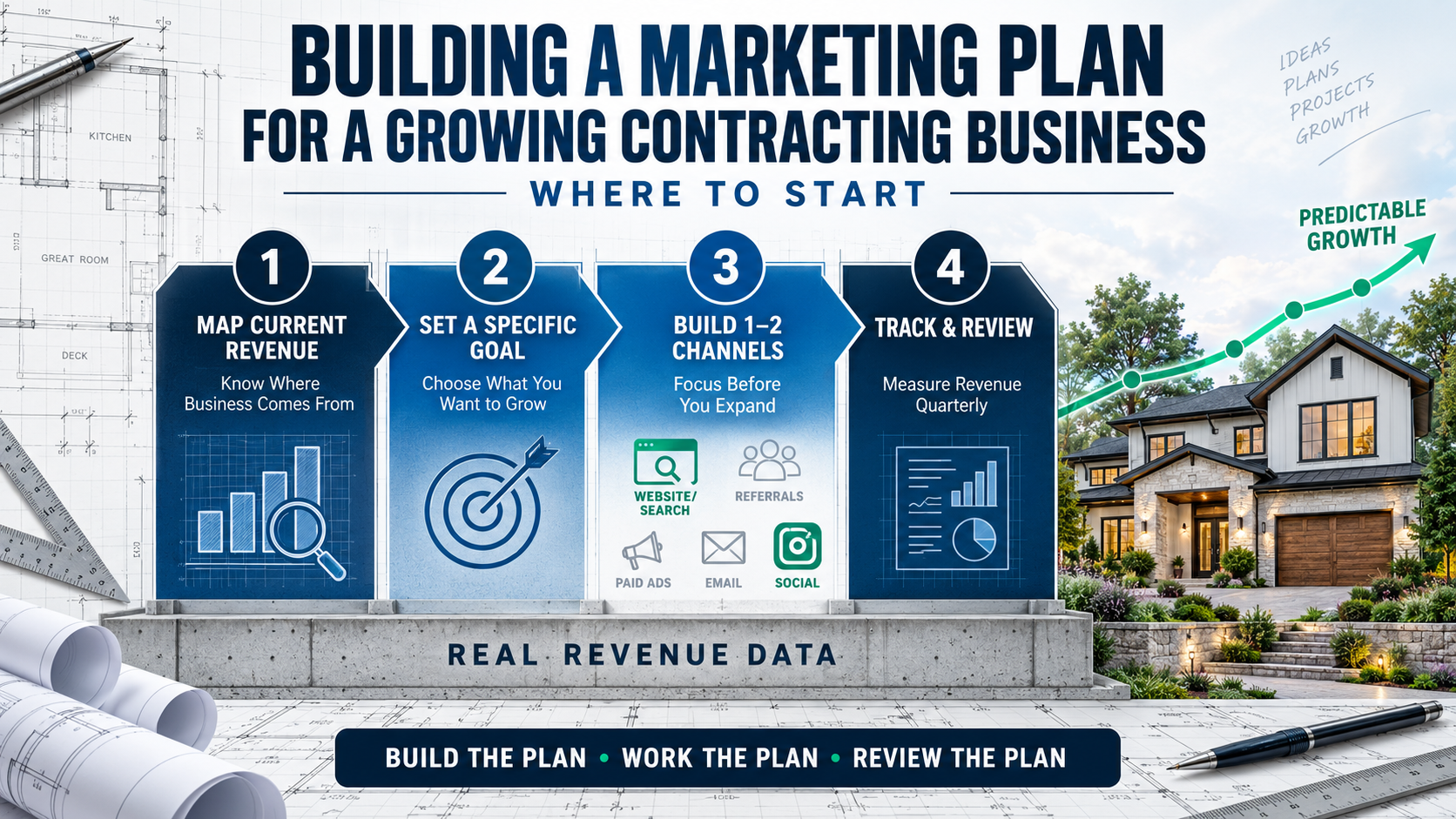
Before building anything new, it's worth mapping out your current lead sources honestly: referrals, past clients, your website, any paid advertising, social media, industry directories. Most owners can list these from memory, but few have an actual sense of what percentage of revenue each one represents. That breakdown alone often reveals how dependent the business is on one or two sources that could dry up or plateau.
Decide what you're actually trying to grow
"More leads" is rarely the most useful goal on its own. More specific goals — more leads for a particular project type, expansion into a new service area, a higher average project value, more leads during historically slow months — lead to a much clearer plan than a vague growth target, because they point directly at which channels and messages actually make sense.
Pick one or two channels to build deliberately, not five
It's tempting to try to be active everywhere — website, ads, social media, email, local SEO — all at once. In practice, this usually means every channel gets a shallow, inconsistent effort instead of one or two getting done well. A more effective starting plan picks the one or two channels most likely to reach your specific audience and commits to doing those consistently for several months before adding more.
Build a simple way to track what's actually working
Even a basic spreadsheet noting where each new lead came from, whether it closed, and at what value is enough to start seeing real patterns. Without this, marketing decisions tend to get made based on which channel feels active or exciting recently, rather than which one is actually producing revenue.
Revisit the plan quarterly, not constantly
A marketing plan doesn't need to be rewritten every month, but it does need to be revisited regularly enough to catch what's working and what isn't. Quarterly is usually a reasonable cadence — frequent enough to adjust before a slow channel wastes months of budget, infrequent enough that you're not abandoning strategies before they've had a real chance to work.
Why a written plan matters more as you grow
At a small scale, an informal approach can work because the owner is close enough to every lead and every job to sense what's working intuitively. As the business grows — more people involved in sales, more marketing spend, more channels running simultaneously — that intuitive sense stops being reliable, and a written plan becomes less about following extra process for its own sake and more about keeping everyone pointed at the same specific goals instead of pulling in different directions.
A marketing plan doesn't need to be elaborate to be useful. It needs to answer, in writing, where your leads currently come from, what you're actually trying to grow, which one or two channels you're committing to, and how you'll know if it's working. Most of the value comes from simply having clear, honest answers to those four questions — not from the plan itself being sophisticated.