
Ask most remodeling business owners how they'd fix a slow month, and you'll hear some version of the same answer: get more leads. It's the obvious lever. It's also, in our experience running pipeline audits for design-build and high-end remodeling companies, almost never the actual constraint.
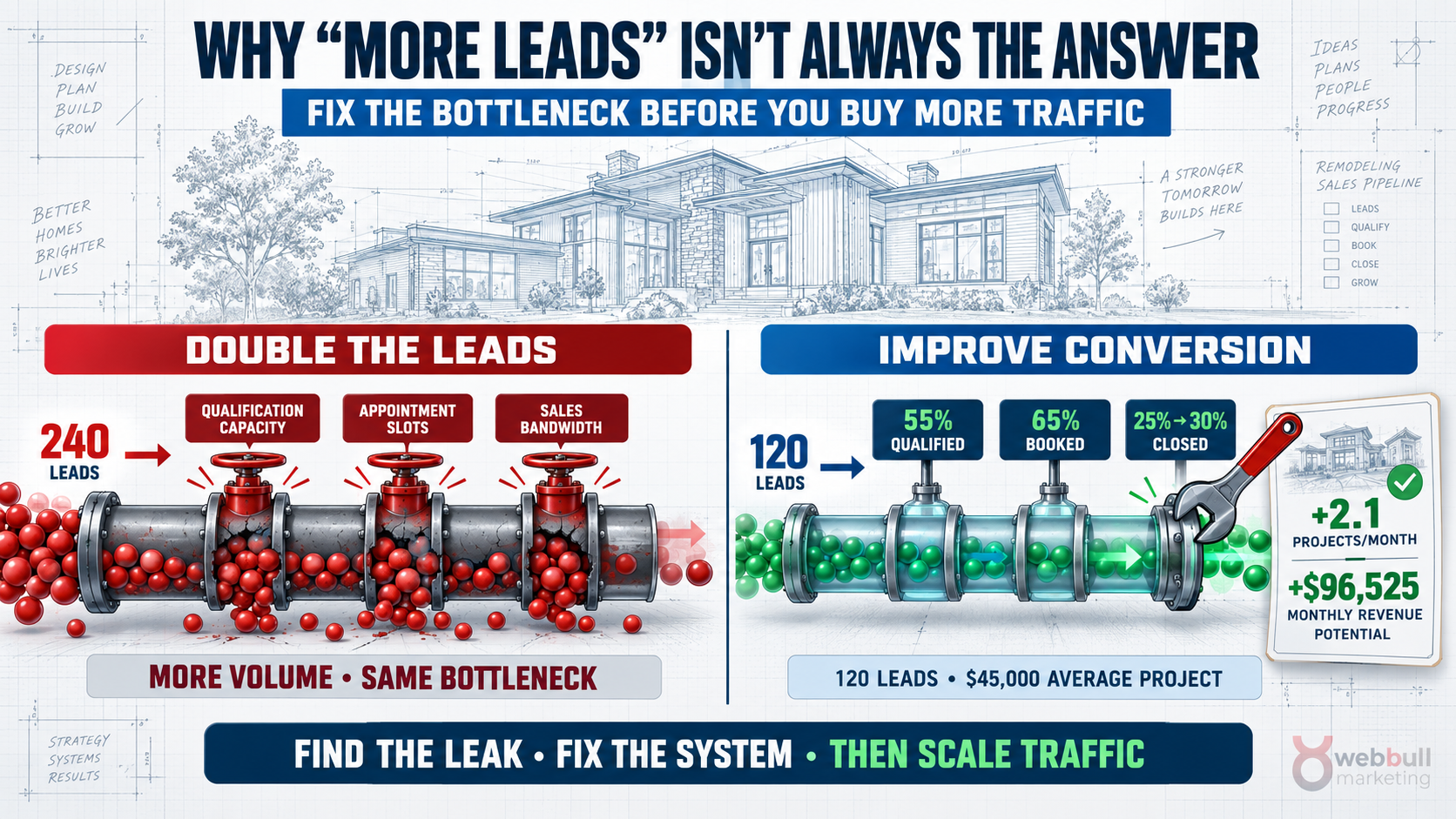
Here's the math that makes this obvious. Say you're bringing in 120 leads per month, a 55% qualification rate and 65% appointment rate produce about 42.9 appointments. At a 25% close rate, that equals roughly 10.7 projects and $482,625 in monthly revenue. Increasing the close rate to 30% produces about 12.9 projects—approximately 2.1 additional projects and $96,525 in added monthly revenue potential.
Now double your lead volume to 240 leads a month, with the exact same conversion rates at every stage. You'd expect double the revenue — but you'll also need double the qualification capacity, double the appointment slots, and double the sales bandwidth to actually close them. If any of those systems were already stretched thin, adding volume doesn't multiply your revenue. It multiplies whichever bottleneck was already there.
Compare that to fixing conversion instead. Take that same 120 leads a month and move your close rate from 25% to 30% — a five-point swing that's well within reach for most companies once the follow-up process gets tighter. That's worth roughly $67,500 a month in additional revenue, without spending another dollar on lead generation.
The number most owners can't answer
Most owners can quote their ad spend and lead count down to the dollar. Far fewer can tell you their real close rate off the top of their head — or their appointment show-up rate, or how many "qualified" leads actually get logged as qualified versus just assumed to be. You can't fix a number you're not tracking.
A quick way to tell which problem you actually have
Before spending more on lead generation, it's worth ruling out a conversion problem first. A few questions that usually surface the answer fast:
- Do you know your close rate for the last 90 days, or would you have to guess?
- When a lead comes in, how long does it typically take before someone follows up?
- Of the appointments you book, what percentage actually show up?
- Can you name the last deal you lost, and why?
If those answers came slowly, or not at all, that's usually a sign the leak is upstream of lead volume.
When more leads genuinely is the right call
To be clear, there are real situations where lead generation is exactly the right investment. If your qualification, appointment, and close rates are already solid and consistent, and you simply don't have enough raw volume to hit your revenue goals, more leads is a legitimate lever. The mistake isn't investing in lead generation — it's investing in it before confirming that's actually where the gap is.
The fastest way to know for sure
Run your actual numbers — leads, qualification rate, appointment rate, close rate, and average project value — through a pipeline calculator and see where the real gap sits before deciding where to spend next. It takes about two minutes, and it's a much cheaper way to find out than a few months of increased ad spend that doesn't move revenue the way you expected.