Marketing a single custom-home community requires precise targeting, strong landing pages, accurate conversion tracking, and continuous optimization.
Managing those elements across more than 16 active communities and over 20 divisions is a different challenge entirely.
In this anonymized case study, a corporate home builder needed to generate demand for mid-range custom homes priced between approximately $200,000 and $500,000.
The available inventory, competitive conditions, buyer demographics, and geographic targets varied by community. Some neighborhoods were actively selling, some were approaching sellout, and others were preparing to launch.
A generic corporate campaign would not have been enough.
The strategy required a coordinated system that could manage local differences while still supporting the builder’s larger brand and revenue goals.
The Challenge: One Brand, Many Local Markets
The builder operated across more than 16 communities, with over 20 divisions involved in supporting those locations.
Although the communities belonged to the same organization, each functioned like its own local market.
Every community had a different combination of:
- Available homes and lots
- Home prices
- Floor plans
- Buyer profiles
- Geographic competition
- Search demand
- Sales priorities
- Inventory constraints
A campaign that performed well for one neighborhood could perform very differently in another.
The marketing system therefore needed to accomplish two goals at the same time:
- Maintain a coordinated corporate strategy.
- Give each active community enough flexibility to respond to its own market.
That required a more deliberate structure than placing every location into one large advertising campaign.
The Paid Search Strategy
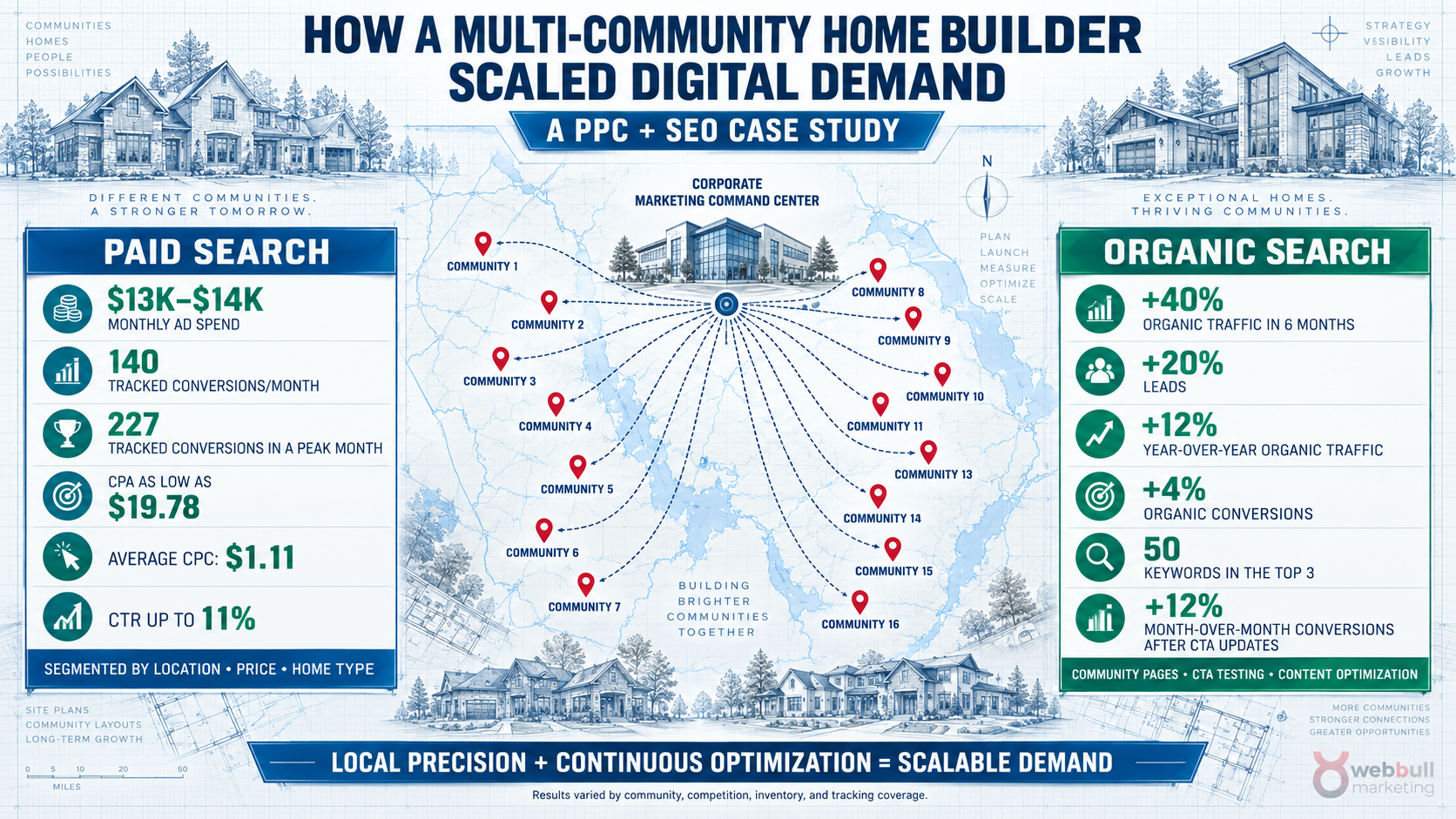
The builder invested approximately $13,000 to $14,000 per month in paid search, depending on how many communities and divisions needed active promotion.
The advertising portfolio included the corporate location and at least 16 communities at a time.
As communities sold out or inventory priorities changed, campaigns were adjusted or rebuilt to redirect advertising toward homes and neighborhoods that were ready to sell.
This prevented the company from continuing to spend budget on communities that could no longer convert demand into available inventory.
Campaigns Were Segmented by Buyer Intent
Rather than relying on broad home-building keywords across the entire portfolio, campaigns were organized around combinations of:
- Community location
- Home price range
- Home type
- Available inventory
- Relevant buyer searches
This created tighter connections between what a prospective buyer searched for, the advertisement shown, and the community page they reached.
A person searching for a specific type of home in a specific market should not be sent to a generic corporate page and expected to locate the right community independently.
The campaigns were designed to capture relevant search demand and direct it to conversion-oriented community pages that matched the buyer’s apparent intent.
Budget Followed Performance and Availability
Multi-location advertising should not operate as a permanent, evenly distributed allowance.
The team continually reviewed which keywords, devices, audiences, and communities were producing conversions. Budget and bidding decisions could then be adjusted based on actual performance and the builder’s current inventory needs.
The optimization process included reviewing:
- Converting search terms
- Irrelevant and ineffective keywords
- Geographic performance
- Device performance
- Demographic patterns
- Income-level targeting
- Click-through rates
- Cost per click
- Cost per tracked conversion
- Community inventory and sales priorities
Campaigns also underwent ongoing testing rather than being launched once and left untouched.
That mattered because buyer behavior, search competition, available inventory, and community priorities changed throughout the campaign.
Paid Search Results
Across the managed accounts, the campaigns consistently generated approximately 140 tracked conversions per month.
During the strongest month, the portfolio generated 227 tracked conversions.
Additional paid-search results included:
- Click-through rates reaching as high as 11% in certain accounts
- Cost per acquisition as low as $19.78 in some communities
- An average cost per click of approximately $1.11
These figures should be interpreted correctly.
The lowest CPA and highest click-through rates were achieved in particular accounts or communities. They were not necessarily the average performance across every market.
Results varied depending on:
- Local competition
- Search volume
- Available homes
- Community size
- Geographic conditions
- Tracking coverage
Some community websites also had conversion-tracking limitations, meaning not every desired action was captured. The reported conversion totals therefore reflected tracked activity rather than a complete record of every inquiry or sale-related action.
Most importantly, tracked conversions should not be confused with completed home sales. A conversion may represent an inquiry, form submission, phone call, appointment request, or another defined marketing action.
The SEO Strategy
Paid search produced immediate visibility, but the builder also needed a stronger long-term source of demand.
The organic-search strategy focused on improving the performance of community pages, strengthening calls to action, increasing engagement, and expanding visibility for competitive and long-tail searches.
The work included:
- Reviewing top-performing community pages
- Updating calls to action
- Adding CTAs to high-engagement pages
- Improving pages with weak engagement
- Auditing keyword performance
- Researching competitor visibility
- Targeting valuable long-tail searches
- Monitoring rankings, traffic, engagement, and conversions
The objective was not simply to attract more visitors. It was to make the existing traffic more likely to become measurable demand.
Small CTA Changes Produced a Measurable Lift
During one optimization period, the team reviewed the builder’s highest-performing community pages and revised the call-to-action language to make the next step clearer and more immediate.
Calls to action were also added to pages already receiving strong visitor engagement.
Those changes contributed to a 12% month-over-month increase in conversions.
This illustrates an important point for builders and remodelers: more traffic is not always the first answer.
If high-intent visitors are already reaching project or community pages but the next step is unclear, conversion improvements may produce results faster than generating additional traffic.
The page must tell prospective buyers what to do next—and give them a compelling reason to do it.
Organic Traffic Increased by More Than 40%
During the first six months of the SEO campaign, organic traffic increased by more than 40%.
That growth contributed to a 20% increase in leads.
In a separate year-over-year comparison, the website generated:
- 12% more organic traffic
- 4% more organic conversions
The difference between traffic growth and conversion growth is meaningful.
Traffic is valuable only when the visitors are relevant and the website successfully moves them toward an inquiry or other desired action.
This is why the SEO strategy included both visibility improvements and conversion-focused page updates.
Competitive Rankings Improved
The builder also gained visibility for competitive regional searches.
Two broad phrases—“Homes in Colorado Springs” and “Homes in North Carolina”—improved by more than 10 ranking positions during the reporting period.
The website also reached the top three organic positions for 50 tracked keywords.
These gains created a stronger search footprint, but rankings were treated as one part of the performance picture rather than the final result.
A high ranking that produces no qualified traffic or conversions has limited business value.
The strategy therefore continued expanding into more specific long-tail keywords capable of matching buyers with relevant communities, locations, price ranges, and home types.
What Made the Strategy Work
The strongest lesson from this campaign is not that builders should simply spend more on PPC or publish more SEO content.
The advantage came from coordination.
Paid search captured active demand. Community pages provided relevant destinations. SEO expanded long-term visibility. CTA testing improved the percentage of existing visitors who converted. Conversion data informed subsequent budget and targeting decisions.
Each part made the others more useful.
1. Local Relevance Was Built Into the Campaign Structure
Campaigns were divided by location, pricing, and home type instead of treating every buyer and community as interchangeable.
This allowed advertising and landing pages to match local intent more closely.
2. Marketing Followed Inventory
Advertising priorities changed as communities sold out, launched, or gained new inventory.
That prevented the budget from becoming detached from what the sales team could actually offer.
3. Community Pages Were Treated as Sales Assets
The website was not merely a digital brochure.
Community pages were reviewed based on engagement and conversion performance. Calls to action were added, rewritten, and tested to make the next step more obvious.
4. Optimization Was Continuous
Keywords, demographics, devices, bids, pages, CTAs, rankings, and engagement were reviewed continually.
The account was treated as an operating system rather than a one-time campaign setup.
5. PPC and SEO Supported Different Time Horizons
Paid search generated immediate visibility in priority markets.
SEO created an organic asset capable of compounding over time.
Using both allowed the builder to pursue near-term conversions while strengthening its longer-term position.
What Remodelers and Design-Build Firms Can Learn From It
Most remodeling companies do not operate 16 communities or manage a five-figure monthly advertising budget.
The underlying principles still apply.
A remodeler serving several cities should not send every visitor to the same generic page. Campaigns and landing pages should reflect the service, location, project type, and investment level the homeowner searched for.
A design-build firm can apply the same framework by segmenting campaigns around combinations such as:
- Kitchen remodeling in a priority city
- Whole-home remodeling in an affluent service area
- Primary-suite additions
- Luxury bathroom remodeling
- Historic-home renovations
- Aging-in-place projects
- Large additions or structural renovations
The goal is not to create dozens of shallow campaigns or duplicate city pages.
It is to create meaningful alignment between:
- What the homeowner wants
- Where the property is located
- What the company offers
- Which page the prospect sees
- What action the prospect is asked to take
The Measurement Lesson
This case study also exposes a frequent weakness in multi-location marketing: incomplete conversion tracking.
If some community pages or website functions cannot record inquiries accurately, campaign reports will understate performance in some places and make budget comparisons less reliable.
Before scaling advertising, builders should verify that each campaign and landing page can track the actions that matter.
That may include:
- Form submissions
- Qualified phone calls
- Appointment requests
- Brochure or floor-plan downloads
- Community-tour bookings
- Chat inquiries
- CRM-qualified opportunities
- Closed sales
The most useful measurement does not stop at cost per conversion.
It connects the campaign to lead quality, sales appointments, and eventually closed revenue.
The Bottom Line
Scaling digital demand across multiple home-building communities requires more than increasing the advertising budget.
It requires a system that can:
- Segment campaigns by local intent
- Direct buyers to relevant community pages
- Shift budget as inventory changes
- Track conversions accurately
- Improve page-level conversion
- Build organic visibility over time
- Connect marketing activity to business outcomes
In this case, the coordinated strategy consistently produced approximately 140 tracked monthly conversions, reached 227 during a peak month, increased organic traffic by more than 40% over six months, and contributed to a 20% increase in leads.
The broader lesson is straightforward:
Local precision and continuous optimization are what make digital demand scalable.
This anonymized historical case study reflects results from a specific campaign period. Performance varied by community, competition, inventory, website functionality, and tracking coverage. These figures are not guarantees of future results.