
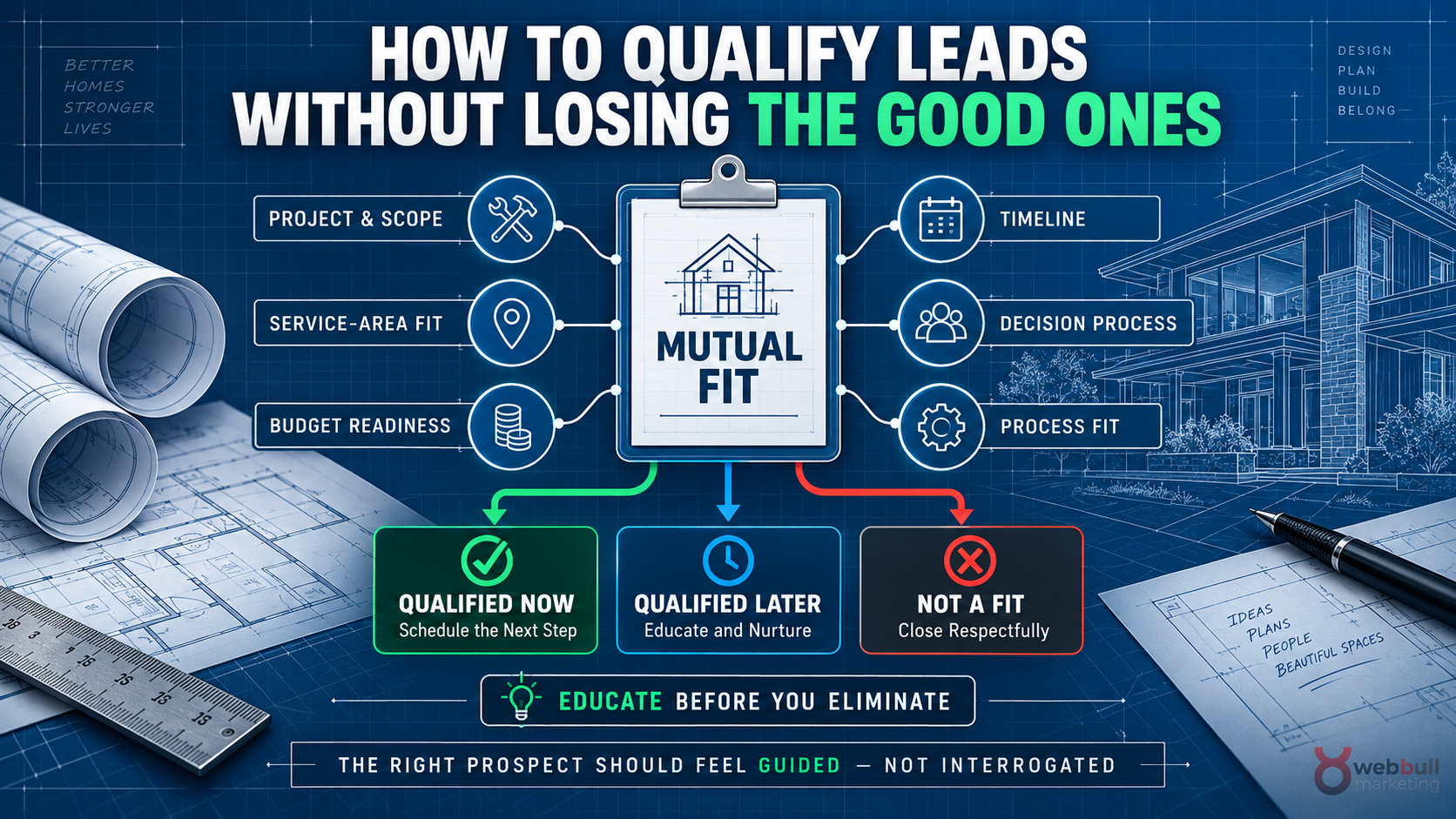
Lead qualification is supposed to prevent remodeling companies from wasting hours on projects that will never move forward.
Done poorly, however, it creates a different problem: strong prospects feel interrogated, dismissed, or pressured before they have had a meaningful conversation with anyone.
That is especially risky for design-build firms and high-end remodelers.
Homeowners considering a major renovation are not purchasing a simple commodity. They may be making one of the largest investments of their lives in a home filled with emotional, financial, and practical considerations.
They expect the contractor to ask questions—but they also expect to feel heard.
The goal of qualification is not to eliminate everyone who cannot immediately provide perfect answers. It is to determine:
- Whether the project fits your services
- Whether the homeowner is realistically prepared to move forward
- What the appropriate next step should be
- How much time your team should invest at this stage
A good qualification process protects your company’s resources while making the right prospects more confident about working with you.
Why Remodeling Lead Qualification Is Different
A homeowner requesting a roof repair may be able to describe the problem, provide an address, and ask for a quote.
A design-build remodeling lead is usually more complicated.
The homeowner may know that the kitchen no longer works for the family but have no idea what the project should cost. They may want to add 800 square feet without understanding zoning restrictions, architectural requirements, or construction timelines.
That uncertainty does not automatically make the lead unqualified.
It means your qualification process must distinguish between a prospect who needs professional guidance and one who is fundamentally incompatible with your business.
Those are not the same person.
The Biggest Qualification Mistake
The most common mistake is treating qualification like an application the homeowner must pass.
A salesperson asks about budget, timeline, property value, decision-makers, financing, and readiness in rapid succession. The homeowner feels as though the company is deciding whether they are worthy of receiving help.
That dynamic is backwards.
Qualification should feel like a mutual-fit conversation. You are determining whether the project fits your company, while the homeowner is deciding whether your expertise, process, and approach fit their needs.
The tone should be:
“Let’s determine the best next step.”
Not:
“Prove that this lead is worth our time.”
What Design-Build Firms Should Qualify
A practical remodeling lead qualification framework should examine six areas.
1. Project Type and Scope
Start by understanding what the homeowner wants to accomplish.
Ask questions such as:
- What areas of the home are you considering remodeling?
- What is not working about the current space?
- Are you planning to change the layout or footprint?
- Does the project involve an addition or structural work?
- Are design and material selections part of the help you need?
- What would a successful result look like for your family?
These questions reveal whether the project matches your company’s capabilities and ideal project profile.
They also allow the homeowner to talk about the reason behind the project—not merely list desired features.
2. Property and Service-Area Fit
Confirm early that the property is within your service area and appropriate for the work you perform.
Useful questions include:
- What is the project address?
- How long have you owned the property?
- Is this your primary residence, an investment property, or a home you are purchasing?
- Are there known HOA, historic-district, zoning, or access restrictions?
- Have any plans, surveys, or architectural drawings already been prepared?
This information can uncover logistical issues without making the conversation feel unnecessarily restrictive.
If the property is outside your service area, respond quickly and helpfully. A professional referral or clear explanation leaves a better impression than allowing the lead to wait several days for a rejection.
3. Budget Readiness
Budget is one of the most important—and most mishandled—qualification topics.
Simply asking, “What is your budget?” often produces an unreliable answer.
Many homeowners genuinely do not know what a well-designed remodeling project costs. Others fear that revealing a number will cause the contractor to price directly up to it.
Instead, provide context before requesting a range.
For example:
“Projects with this type of structural work, design involvement, and finish level often begin around a certain investment range and can increase depending on selections and complexity. Is that generally consistent with what you were expecting?”
This approach does three things:
- Educates the homeowner
- Establishes realistic expectations
- Invites an honest response without turning the conversation into a financial interrogation
If the homeowner’s expectations are far below the likely investment, do not immediately label the lead as bad.
Determine whether the gap comes from a true financial limitation or a lack of current market knowledge. A homeowner who initially guessed incorrectly may still be capable of adjusting the scope, timeline, or financing plan.
4. Timeline and Urgency
Ask why the homeowner is considering the project now.
The answer often reveals more than asking for a preferred start date.
Common motivations include:
- A growing or multigenerational family
- Aging-in-place needs
- Damage or functional problems
- An upcoming life event
- Preparing to work from home
- Purchasing or moving into the property
- Wanting the project completed before a particular season
Then clarify expectations:
- Is there a firm completion deadline?
- Is the homeowner flexible about when construction begins?
- Are they prepared for the design, planning, permitting, and selection phases?
- Are they interviewing contractors now or gathering information for a future project?
A prospect planning 12 months ahead is not necessarily unqualified. That person may belong in a structured nurture process instead of an immediate sales appointment.
5. Decision-Making Process
A major remodeling project rarely has only one stakeholder.
Ask:
- Who will be involved in making the final decision?
- Will everyone involved be able to attend the consultation?
- Are there competing priorities within the household?
- Has the family completed a remodeling project before?
- What factors will matter most when choosing a design-build partner?
Avoid the aggressive “Are you the decision-maker?” language inherited from transactional sales scripts.
For residential remodeling, this is often a family decision. The purpose is to understand the process and ensure that important stakeholders receive the same information.
6. Fit With Your Process
A financially qualified homeowner can still be a poor fit if their expectations conflict with how your company operates.
Explain your process clearly:
- Whether you provide design and construction together
- Whether preconstruction or design agreements require payment
- How selections and allowances are handled
- How long planning typically takes
- Whether the home can remain occupied during construction
- How communication and change orders are managed
Then ask whether that approach aligns with what the homeowner is seeking.
This prevents both parties from investing time in a relationship built on incompatible expectations.
Use Three Outcomes, Not Just Qualified or Rejected
A binary qualification system forces every lead into one of two categories:
- Qualified
- Unqualified
That is too blunt for remodeling sales.
Use three primary outcomes instead.
Qualified Now
The project fits your services, location, typical investment level, general timeline, and process.
The next step might be a discovery call, on-site consultation, showroom meeting, feasibility review, or paid design engagement.
Qualified Later
The prospect appears to be a legitimate future opportunity but is not ready for an active sales process.
Reasons may include:
- The project is six to eighteen months away
- Financing is not finalized
- The homeowner is waiting to purchase the property
- Another life event must happen first
- The scope still requires education and planning
Place these prospects into a useful nurture sequence rather than repeatedly asking, “Are you ready yet?”
Send relevant project examples, planning guides, cost information, timelines, and local insights that help them prepare.
Not a Fit
The project falls outside your service area, required scope, minimum investment, construction model, or capacity.
Close the opportunity respectfully and document the reason in your CRM.
Where appropriate, provide a resource or referral. Today’s poor-fit lead may still become a referral source, future client, or enthusiastic reviewer of how professionally your company handled the conversation.
How to Ask Qualification Questions Without Sounding Cold
Explain why you are asking.
Compare these two approaches:
“What is your budget?”
Versus:
“To help us determine whether our process fits the project—and avoid recommending a next step that does not make financial sense—may I ask what investment range you are currently considering?”
The second version gives the question context.
Use transitions such as:
- “To make sure we guide you correctly…”
- “So I can recommend the right next step…”
- “To avoid wasting your time…”
- “Because projects like this can vary significantly…”
- “Let me give you some context before I ask about budget…”
Qualification feels less intrusive when homeowners understand how their answers will be used.
Do Not Make the Website Form Do the Entire Job
A website form can collect useful preliminary information, but every additional field creates friction.
Ask only for information that changes what happens next.
A strong initial remodeling inquiry form might request:
- Name
- Phone number
- Project address or ZIP code
- Project type
- Brief project description
- Desired timeline
- Preliminary investment range
- How the homeowner heard about the company
Avoid requiring homeowners to answer 20 detailed questions before anyone has established value or trust.
The website form should begin the qualification process—not replace a human conversation.
Qualify Quickly, but Do Not Rush the Prospect
Speed matters when responding to new inquiries. That does not mean the qualification conversation should feel rushed.
Contact the lead promptly, then slow the conversation down enough to understand what is actually happening.
A five-minute call focused on checking boxes may miss an excellent project because the homeowner used the wrong terminology or had unrealistic assumptions that could have been corrected with two minutes of education.
Efficiency comes from having a consistent framework—not from ending every conversation as quickly as possible.
Track Why Leads Are Disqualified
“Not qualified” is not a useful CRM status unless the reason is documented.
Track categories such as:
- Outside service area
- Project type not offered
- Investment mismatch
- Timeline mismatch
- Unable to contact
- Not the property owner
- Not ready
- Chose another contractor
- Duplicate or spam
- Referred elsewhere
Review these reasons regularly.
If a large percentage of leads are outside your service area, your advertising geography may be too broad. If most inquiries are below your minimum investment, your website and advertising may not be setting expectations clearly.
Disqualification data is not merely a sales report. It is marketing intelligence.
Measure Whether Qualification Is Too Loose—or Too Aggressive
Track what happens after qualification.
Useful metrics include:
- Percentage of total leads qualified
- Qualified leads who book consultations
- Appointment show-up rate
- Qualified-lead-to-sale rate
- Held-appointment close rate
- Average project value by lead source
- Most common disqualification reasons
If almost every lead gets qualified but few attend appointments or close, the standards may be too loose.
If very few leads qualify and sales volume is consistently weak, the standards may be too aggressive—or marketing may be attracting the wrong audience.
The goal is not the highest possible qualification rate. It is a reliable flow of appropriate opportunities.
The Bottom Line
Effective lead qualification should improve the homeowner’s experience, not create an obstacle course.
Ask enough to understand the project, investment expectations, timing, decision process, property, and fit with your company’s approach. Explain why sensitive questions matter. Educate before rejecting assumptions. Separate future opportunities from genuine mismatches.
Most importantly, remember what qualification is designed to accomplish:
Protect your team’s time while helping the right homeowners take the right next step.
When the process does both, you stop wasting sales capacity without accidentally pushing good projects toward a competitor.