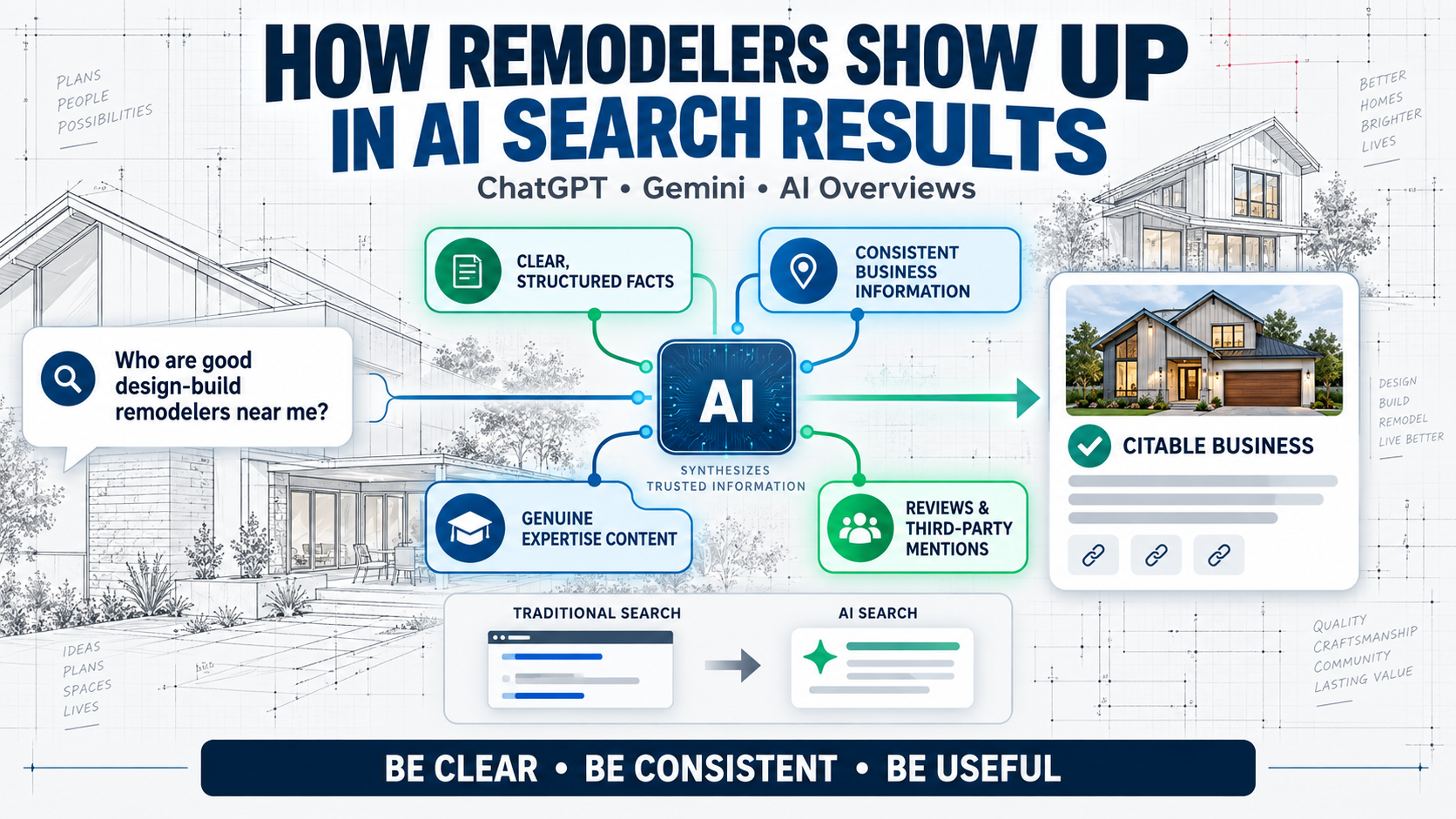
A homeowner researching a remodel today might not start with a Google search at all — they might ask ChatGPT, Gemini, or a similar AI tool directly: "who are good design-build remodelers near me" or "what should I expect to pay for a kitchen remodel in my area." How these tools answer that question, and whether your company shows up in the answer, is a newer and less understood piece of marketing than traditional SEO — but it's worth paying attention to early rather than catching up later.
This is genuinely different from ranking in Google
Traditional SEO optimizes for a list of ranked links. AI search tools synthesize an answer, often citing a small number of sources, or sometimes no specific source at all, drawing instead on general patterns across the web. Being "rankable" and being "citable" aren't the same skill, and the practices that help with one don't automatically help with the other.
What tends to make a business easier for AI tools to reference
Based on how these tools currently seem to work, a few things appear to help, though it's worth being upfront that this space is new and still evolving, and no one — including AI companies themselves — has published a definitive playbook:
- Clear, structured, factual content about what you do, who you serve, and where — AI tools tend to favor content that states things plainly rather than burying them in marketing language
- Consistent information across the web — the same service area, business description, and specialties repeated accurately across your website, directories, and profiles, since inconsistency makes it harder for any system (AI or otherwise) to confidently describe your business
- Genuine expertise content — detailed, specific articles (like this one) that AI tools can draw on for a real answer, rather than thin or purely promotional pages
- Reviews and third-party mentions — being referenced accurately on other reputable sites and platforms appears to reinforce how confidently an AI tool describes your business
What's realistically within your control right now
You can't optimize directly for a specific AI tool's internal ranking system the way you might target a Google Ads keyword — these systems don't offer that kind of direct control today. What you can do is make sure the fundamentals are solid: accurate, consistent, detailed information about your business across your website and every platform that mentions you, plus genuinely useful content that answers real questions homeowners are asking. That's the same foundation that helps traditional SEO, which is a reassuring overlap — you're not choosing between optimizing for Google and optimizing for AI tools, you're building the same foundation for both.
A reasonable way to approach this today
Treat AI search visibility as a reason to be more thorough and more consistent with your existing marketing fundamentals, not as a separate, exotic new channel requiring an entirely different strategy. The businesses likely to benefit as this space matures are the ones with clear, accurate, well-documented information already in place — which is worth having anyway, regardless of how AI search specifically evolves from here.