
Ask most remodeling business owners how their website is doing, and the answer usually comes back to one number: traffic. More visitors feels like progress. In practice, traffic on its own tells you almost nothing about whether your website is actually helping the business.
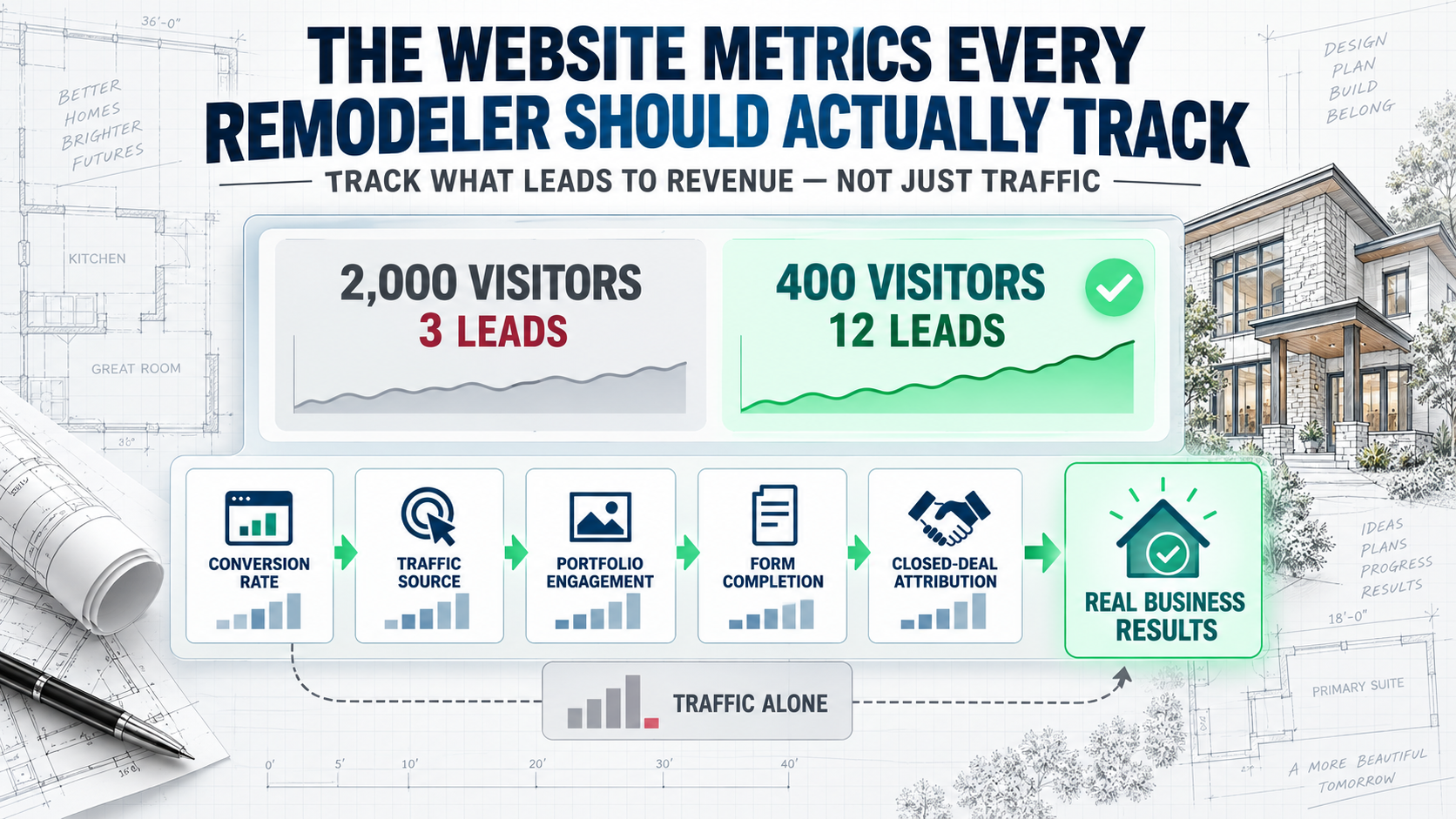
A website with 2,000 visitors a month and 3 leads is performing worse than a website with 400 visitors and 12 leads, even though the first one looks more impressive in a screenshot. The metrics worth watching are the ones that sit closer to revenue, not the ones that are easiest to glance at.
Conversion rate, not just visitors
The percentage of visitors who actually take an action — filling out a form, calling, booking a consultation — matters far more than raw traffic. A remodeler site converting at 3-5% of visitors into leads is generally healthy; below 1% usually points to a message or design problem, not a traffic problem, and no amount of additional traffic will fix that on its own.
Where visitors actually come from
Traffic from a Google search for "[your city] kitchen remodeler" behaves very differently than traffic from a Facebook ad or a random blog link. Lumping all traffic together hides which sources are actually bringing in people ready to hire, versus people just browsing. Segmenting this — even just splitting "search," "social," "direct," and "referral" — usually reveals that one or two sources are doing most of the real work.
Time on the portfolio or project pages
For a high-end remodeler, the portfolio is often doing more selling than any single page of text. If visitors are landing on your homepage and leaving in under a minute, or never making it to your project photos at all, that's a strong signal the site isn't guiding people toward the content that actually builds trust and moves them toward reaching out.
Form abandonment
If your analytics can show you how many people start filling out a contact form but never submit it, that number is worth paying attention to. A high abandonment rate usually means the form is too long, asks for information too early, or feels like a commitment before the visitor is ready to make one.
Lead source attribution, tied back to closed deals
The most useful version of all this is connecting website data back to your CRM — which leads actually came from the website, and which of those actually closed. Without that connection, it's easy to overvalue a source that generates a lot of form fills but very few real customers, or undervalue a quieter source that consistently brings in serious buyers.
Why this matters more than a redesign
It's tempting to treat a stalling website as a design problem — new colors, a new layout, better photos. Sometimes that's the right call. But just as often, the site's design is fine and the real issue is invisible without looking at these numbers: the wrong traffic is arriving, or the right traffic is arriving and dropping off at a specific, fixable point. Tracking the right metrics is what tells you which situation you're actually in, instead of guessing and rebuilding a site that wasn't the problem in the first place.